Our Theory of Change
Building stronger local economies through solidarity
JENGE Kulture adopts a Systems Theory of Change grounded in The SESS Model.
We believe lasting economic transformation happens when people build collective power, strengthen solidarity-driven enterprises, influence enabling systems, and create the capabilities and resources needed to sustain and spread change.
Why a Systems Theory of Change?
Economic challenges are rarely caused by a lack of individual effort alone. They are shaped by the relationships, institutions, markets, resources and systems within which people live and work.
For creators and young people, this means that building individual skills or supporting individual enterprises is important – but often not enough.
We believe sustainable change requires us to strengthen the conditions around people and enterprises, not just the people and enterprises themselves. Our Systems Theory of Change provides the framework through which we understand these relationships and our work is guided.
Our Pathway to Change
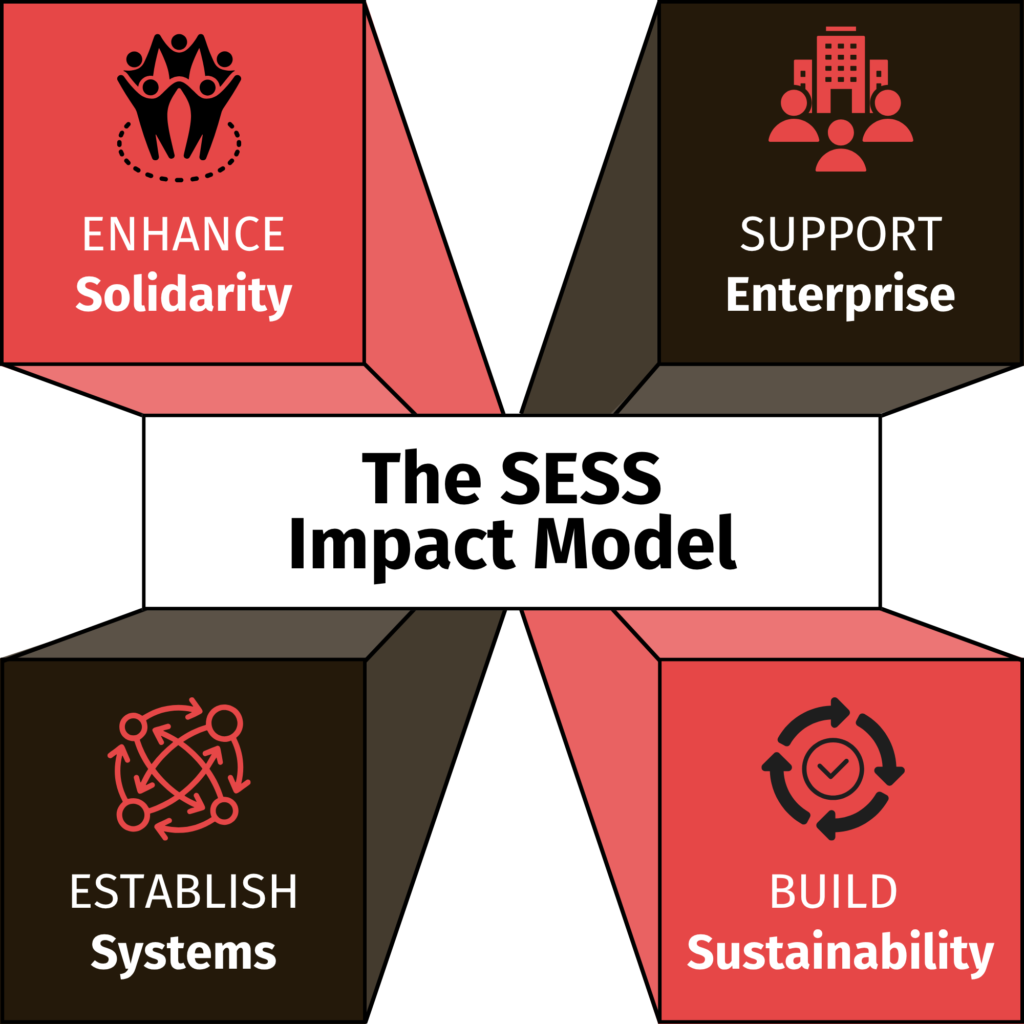
The SESS Impact Model
The SESS Model is JENGE Kulture’s strategic framework for catalysing resilient and inclusive creative economies across Africa through a solidarity-driven approach.
Represented by the acronym SESS (Solidarity, Enterprise, Sustainability, Systems) this model outlines four (4) interconnected pillars of change.
We believe that lasting economic transformation happens when people build collective power, strengthen solidarity-driven enterprises, influence enabling systems, and create the capabilities and resources needed to sustain and spread change. The SESS Model guides how we design our work, measure our contribution and learn what works as we work towards more resilient, inclusive and sustainable local creative economies.
Solidarity
Solidarity strengthens collective power and agency.
People and communities are better able to address economic and social challenges when they are connected through relationships of mutual support, trust, reciprocity and collective action. Solidarity provides the foundation for people to pool resources, share knowledge, support one another and act collectively.
Enterprise
Enterprises turn collective power into economic value.
Solidarity-driven enterprises provide practical vehicles through which people organise economic activity, create livelihoods, generate and share value, and demonstrate more equitable and democratic ways of participating in the economy.
Systems
Systems create the conditions for solidarity-driven economic activity to thrive.
Policies, institutions, markets, infrastructure, finance, networks and narratives shape the opportunities and constraints facing people and enterprises. Stronger and more enabling systems can allow solidarity-driven approaches to grow, connect and influence wider economic practice.
Sustainability
Sustainability enables change to endure, regenerate and spread.
Lasting change requires the capabilities, resources, institutions, leadership, knowledge and practices necessary to maintain and renew progress over time. Sustainability also means that effective solidarity-driven approaches can be adapted, replicated and embedded beyond individual interventions or periods of external support.
Our Role in Turning this Theory to Impact
We translate our Theory of Change into action by building, connecting and strengthening the conditions through which solidarity-driven economies can thrive.
We work with creators, enterprises, communities, institutions and other partners to strengthen collective capacity, develop practical solutions, influence systems and mobilise resources for lasting change. Our role is to catalyse change by connecting and strengthening the people, enterprises and systems that can create and sustain it.